
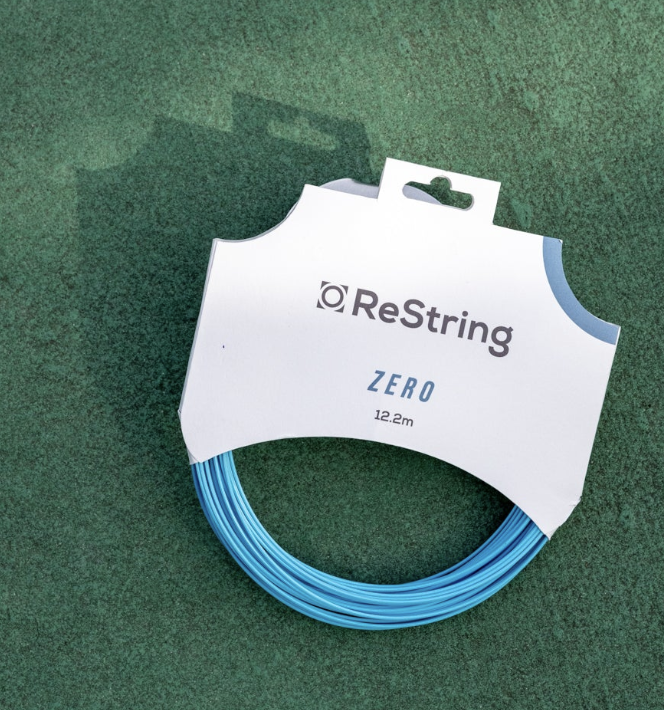
ReString Zero Review: The Spin String That Changed the Conversation
Share
There is a very short list of strings that genuinely change the conversation about what a polyester string can do. ReString Zero is on that list. Becket at TennCom put it plainly after testing it against the field: "Hyper-G is dead. RPM Blast is dead. Long live ReString Zero." That is not a casual statement from someone who reviews strings for a living. It means something.
So what is it actually doing that has people talking? The answer is in the construction — and once you understand it, the performance makes complete sense.
What ReString Zero Actually Is
ReString Zero is a hexagonal six-sided co-polyester — sharp edges that bite into the ball at contact, combined with a lubricated snapback coating that dramatically reduces friction between the mains and crosses. The key detail about that coating is that it's not a surface treatment. It's integrated throughout the construction, which means as the string wears and notches develop, the coating keeps working. Most lubricated strings lose their slipperiness as the outer layer goes; Zero does not. TennCom describes it as playing "more like an infusion than a coating." That distinction matters enormously for playability duration.
It comes in two gauges: 1.23mm (17G) and 1.28mm (16G). The 1.23mm has more bite and feel; the 1.28mm adds durability without giving up much of the character. Most players should start at 1.23mm.
The Spin Story — and Why the Numbers Are Worth Knowing
The reason Zero gets compared to Hyper-G and RPM Blast isn't just marketing — it's because those were the benchmarks for spin before Zero came along. ProStrung's lab testing gives Zero a spin score of 95% — one of the highest recorded. It earns that through both mechanisms at once: the hexagonal edges grip the ball aggressively, while the low-friction coating lets the strings slide and snap back with minimal resistance. High ball-to-string friction and low string-to-string friction simultaneously — the ideal combination for spin production.
In terms of lasting that spin performance, Zero pulls ahead of everything it's typically compared to. TennCom found it lasts approximately 5x longer than RPM Blast and at least 2x longer than Hyper-G before the spin and snapback degrade. For club players who restring every few weeks, that kind of durability gap is the difference between a string that's still performing at your Thursday night match and one that's already half-dead.
How It Feels on Court
Zero plays firm and direct — this is not a soft or arm-friendly string. The hexagonal profile combined with the co-poly construction produces a crisp, fast response off the stringbed with excellent control. Tennisnerd describes it as offering "good bite" and "good spin potential for a relatively comfortable string" — the "relatively" doing a lot of work there. It is not harsh, but it rewards confident swings and doesn't give much back if you guide the ball.
One honest limitation worth flagging: Zero doesn't offer a lot of feedback. Off-centre hits don't announce themselves clearly, which means players who rely on tactile feedback to self-correct may find it harder to read their own technique. It's a string that plays best when you're already hitting cleanly and want the string to amplify the output — not diagnose the problem.
Who Should Be Playing ReString Zero
The clear target is aggressive baseliners who generate pace and topspin with full swings and want the string to keep up rather than limit them. Think 4.0+ players who already have the swing speed to activate shaped strings properly, but have been frustrated by Hyper-G going dead too quickly or RPM Blast demanding a restring every couple of weeks. Zero solves both of those problems while matching or exceeding their spin output.
If you're coming from a round poly and want more spin, Zero is the obvious next step — but go in knowing the character is firmer than a round string. String 2 lbs below your usual poly tension to give it room to breathe; ReString recommend the 43–55 lbs range. Mid-flex frames handle it comfortably; stiffer frames (RA 65+) should sit at the lower end of that range. Pick up a set here.
ReString Zero vs Hyper-G vs RPM Blast
The comparison is worth being clear about. All three are spin-first polys, but they're not interchangeable:
vs Solinco Hyper-G: Hyper-G is a square-profiled poly with a firmer, more demanding character. Zero matches or exceeds it for spin while being less harsh on the arm and lasting significantly longer before the spin degrades. If you love Hyper-G but find yourself restringing too often, Zero is the upgrade.
vs Babolat RPM Blast: RPM Blast is an octagonal co-poly — less aggressive edge geometry than Zero's hexagonal profile, firm feel, reliable spin. Zero outperforms it for spin output and durability by a significant margin. RPM Blast is the established benchmark; Zero has cleared it. The main thing RPM Blast has going for it is familiarity and widespread availability.
Frequently Asked Questions — ReString Zero
What shape is ReString Zero?
ReString Zero is a hexagonal (six-sided) co-polyester. The sharp edges bite into the ball at contact to generate aggressive topspin, while a lubricated coating reduces inter-string friction for fast snapback. Both mechanisms work together to produce some of the highest spin output of any string currently tested.
Is ReString Zero arm-friendly?
It is not a soft string — the hexagonal profile and firm co-poly construction produce a direct, crisp response. Players with arm sensitivity should string at the lower end of the recommended range (43–48 lbs) and consider a hybrid with a softer cross string. That said, it is more comfortable than the stiffer shaped polys it competes with at similar spin outputs.
How does ReString Zero compare to Solinco Hyper-G?
Both are spin-focused shaped polys, but Zero's lubricated coating gives it a significant durability advantage — lasting roughly twice as long as Hyper-G before spin and snapback degrade. Zero also uses a hexagonal profile vs Hyper-G's square, which creates a different feel at contact. For players frustrated by Hyper-G's tension drop-off, Zero is the logical next string.
What tension should I string ReString Zero at?
ReString recommend 43–55 lbs, strung approximately 2 lbs below your usual poly tension. In stiffer frames (RA 65+), stay toward the lower end of that range. The string plays firmer than its gauge suggests, so do not be afraid to go lower than usual — it will not cost you control.
What is the difference between ReString Zero and ReString Slap?
Both share the same hexagonal profile and snapback coating, but Slap is engineered with added forgiveness on off-centre hits and a slightly softer response. Zero is the more aggressive, maximum-spin option; Slap suits players who want similar spin characteristics with a bit more margin for error. If Zero feels demanding, Slap is the natural step back.
ReString Zero is not a string for everyone — it's firm, demanding, and built for players who swing with intent. But for that player, it is genuinely one of the best things to happen to the spin string category in years. The spin numbers are real, the durability claim holds up under independent testing, and the coating technology is a legitimate innovation. Available here in 1.23mm and 1.28mm.